Search Engine Optimization (SEO) Starter Guide (2026) Complete Beginner’s Guide
Introduction
Search Engine Optimization (SEO) is one of the most effective digital marketing strategies for increasing website visibility, attracting qualified visitors, and growing a business online. Whether you own a small business, manage an eCommerce store, run a blog, or provide professional services, SEO helps potential customers discover your website through search engines like Google.
Unlike paid advertising, SEO focuses on earning organic traffic by improving your website’s content, structure, speed, and overall user experience. Although SEO continues to evolve with advancements in artificial intelligence and search technology, its core objective remains the same: delivering the most relevant, helpful, and trustworthy content to users.
This beginner-friendly SEO Starter Guide explains the fundamentals of SEO, how search engines work, and the best practices you can follow to improve your website rankings in 2026.
What is SEO?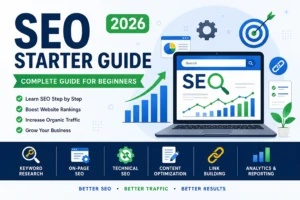
SEO (Search Engine Optimization) is the process of optimizing a website so that it appears higher in search engine results pages (SERPs) for relevant keywords. Higher rankings generally lead to more organic traffic, greater brand visibility, and increased opportunities for conversions and sales.
The main goals of SEO include:
- Increasing organic website traffic
- Improving online visibility
- Building trust and authority
- Generating high-quality leads
- Enhancing user experience
- Increasing sales and business growth
How Search Engines Work
Search engines use automated programs called crawlers or bots to discover and organize web pages.
The process consists of three main stages:
1. Crawling: Search engine bots visit websites by following links and discovering new pages.
2. Indexing: The discovered pages are analyzed and stored in a massive search index.
3. Ranking: When users search for information, search engines evaluate hundreds of ranking factors to display the most relevant results.
Factors such as content quality, website speed, mobile usability, backlinks, and user experience all influence rankings.
Types of SEO
On-Page SEO
On-page SEO involves optimizing elements that exist on your website.
Examples include:
- Optimized page titles
- Meta descriptions
- Proper heading structure
- Keyword placement
- Internal linking
- Image optimization
- URL structure
- High-quality content
Off-Page SEO
Off-page SEO focuses on improving your website’s authority through external signals.
Common techniques include:
- Building quality backlinks
- Guest blogging
- Brand mentions
- Digital PR
- Social media promotion
Technical SEO
Technical SEO ensures that search engines can efficiently crawl and index your website.
Important technical factors include:
- XML Sitemap
- Robots.txt
- HTTPS security
- Mobile responsiveness
- Fast loading speed
- Structured data (Schema)
- Canonical URLs
- Core Web Vitals
Keyword Research
Keyword research is the foundation of every successful SEO strategy. It helps identify the words and phrases that users type into search engines.
Different keyword categories include:
- Short-tail keywords
- Long-tail keywords
- Informational keywords
- Commercial keywords
- Transactional keywords
- Local keywords
Choosing keywords with strong search intent and realistic competition helps improve your chances of ranking.
Creating SEO-Friendly Content
Content remains the most important element of SEO. Search engines reward content that provides genuine value and answers users’ questions effectively.
When creating content:
- Understand your audience
- Write original articles
- Use simple language
- Organize content with headings
- Include relevant images
- Add internal links
- Update outdated information
- Focus on solving real problems
Avoid keyword stuffing. Instead, write naturally and include related terms where appropriate.
Optimizing Titles and Meta Descriptions
The page title is one of the strongest on-page ranking signals.
A good title should:
- Include the primary keyword
- Be clear and descriptive
- Stay within 50–60 characters
- Encourage users to click
Meta descriptions should summarize the page in approximately 140–160 characters while including relevant keywords and a compelling call to action.
Image SEO
Images improve user engagement but should also be optimized for search engines.
Best practices include:
- Compress image files
- Use descriptive filenames
- Add meaningful ALT text
- Choose modern formats such as WebP
- Enable lazy loading
Optimized images improve both accessibility and page speed.
Internal Linking
Internal links connect related pages within your website.
Benefits include:
- Helping search engines discover pages
- Improving website navigation
- Distributing page authority
- Keeping visitors engaged for longer
Every important page should receive internal links from other relevant content.
Mobile SEO and Page Speed
With mobile-first indexing, search engines primarily evaluate the mobile version of a website.
Ensure your website:
- Loads quickly
- Works on all screen sizes
- Uses responsive design
- Has readable text
- Features easy navigation
Fast websites provide a better user experience and often achieve better rankings.
Local SEO
Businesses serving specific geographic locations should focus on Local SEO.
Key strategies include:
- Creating a Google Business Profile
- Encouraging customer reviews
- Using location-based keywords
- Maintaining consistent business information
- Adding Local Business Schema markup
Local SEO helps businesses appear in local search results and map listings.
Measuring SEO Performance
SEO success should be monitored regularly.
Important metrics include:
- Organic traffic
- Keyword rankings
- Click-through rate (CTR)
- Bounce rate
- Conversion rate
- Indexed pages
- Core Web Vitals
- Backlink growth
Regular analysis helps identify opportunities for improvement and measure long-term progress.
Common SEO Mistakes
Many beginners make mistakes that negatively affect rankings.
Avoid:
- Keyword stuffing
- Duplicate content
- Slow websites
- Broken links
- Missing meta descriptions
- Poor mobile optimization
- Thin content
- Ignoring technical SEO
- Not updating older content
Correcting these issues can significantly improve search performance.
SEO Trends in 2026
SEO continues to evolve alongside artificial intelligence and changing user behavior.
Important trends include:
- AI-assisted content creation with human expertise
- Experience-driven, trustworthy content
- Entity-based optimization
- Voice search optimization
- Video SEO
- Visual search
- Structured data implementation
- User experience optimization
- Faster websites and Core Web Vitals
Businesses that focus on quality, originality, and user satisfaction will be better positioned for long-term SEO success.
Conclusion
Search Engine Optimization is a long-term investment that delivers sustainable growth. Rather than trying to manipulate search rankings, successful SEO focuses on creating valuable content, improving website performance, and providing an excellent user experience.
By understanding how search engines work, conducting proper keyword research, optimizing on-page and technical elements, and consistently publishing high-quality content, beginners can build a strong SEO foundation. As search technology continues to evolve in 2026, websites that prioritize helpful, trustworthy, and user-focused content will have the greatest opportunity to achieve lasting visibility and organic traffic.