Why Every Business Needs a Website in 2026: The Complete Guide to Digital Success
Introduction
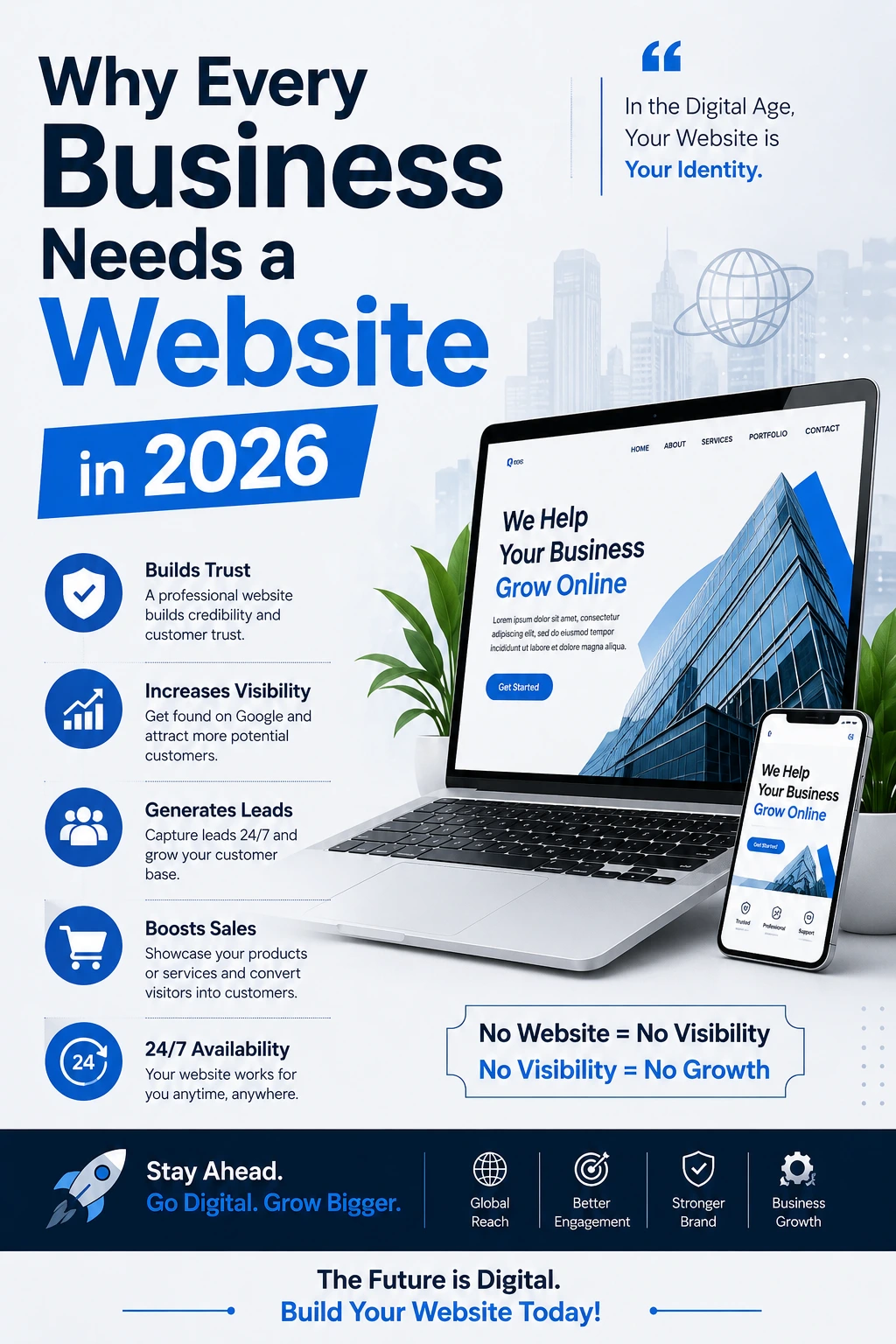
The business landscape has changed dramatically over the last decade. Today, customers search online before making purchasing decisions, comparing products, reading reviews, and evaluating businesses. In 2026, having a website is no longer a luxury or an optional marketing tool—it is a necessity.
Whether you run a small local shop, a startup, a consulting firm, a manufacturing company, or a large enterprise, your website serves as the digital foundation of your business. It acts as your online office, salesperson, customer support center, marketing platform, and brand ambassador—all operating 24 hours a day.
Many business owners still rely heavily on social media platforms alone. While social media remains important, it cannot replace the power, ownership, flexibility, and credibility that a professional website provides.
This comprehensive guide explains why every business needs a website in 2026 and how a well-designed website can help you attract customers, build trust, generate leads, and increase revenue.
The Digital Transformation of Consumer Behavior
Modern consumers have become increasingly digital.
Before purchasing a product or service, customers typically:
- Search on Google
- Visit company websites
- Compare competitors
- Read customer reviews
- Check pricing
- Verify business legitimacy
- Explore products and services
- Review contact information
Research consistently shows that most consumers conduct online research before making buying decisions.
If your business does not have a website, potential customers may:
- Question your credibility
- Choose competitors
- Assume your business is outdated
- Find it difficult to contact you
- Miss valuable information
A website ensures your business remains visible where customers are actively searching.
Your Website Is Your Digital Storefront
Imagine opening a physical store without a signboard, address, or display area.
That’s exactly how many businesses operate online without a website.
Your website functions as:
- Digital showroom
- Online office
- Information center
- Sales platform
- Customer support hub
Unlike a physical location, a website operates 24/7.
Potential customers can:
- Learn about your services
- Browse products
- Submit inquiries
- Request quotes
- Make purchases
- Contact your team
All without requiring your direct involvement.
Building Trust and Credibility
Trust is one of the most valuable assets in business.
In 2026, customers expect legitimate businesses to have professional websites.
A website helps establish credibility through:
Professional Branding
A professionally designed website demonstrates that your business is serious and established.
It communicates:
- Brand identity
- Company values
- Expertise
- Professionalism
Customer Testimonials
Displaying customer reviews builds confidence among potential buyers.
Testimonials provide social proof that your products or services deliver results.
Portfolio and Case Studies
Businesses can showcase:
- Previous projects
- Success stories
- Client achievements
- Industry expertise
This evidence helps customers make informed decisions.
Google Search Visibility and SEO
Search engines remain one of the most powerful customer acquisition channels.
Every day, millions of users search for:
- Products
- Services
- Local businesses
- Solutions
- Professional expertise
Without a website, your business cannot effectively compete for search visibility.
Benefits of SEO
Search Engine Optimization (SEO) helps businesses:
- Rank higher on Google
- Increase organic traffic
- Generate qualified leads
- Improve brand awareness
- Reduce advertising costs
A website serves as the foundation of your SEO strategy.
24/7 Business Availability
One of the greatest advantages of a website is constant availability.
Unlike physical offices that close at night, websites remain accessible around the clock.
Customers can:
- Explore services
- Download information
- Submit forms
- Request appointments
- Make purchases
Even while you sleep.
This continuous accessibility significantly increases opportunities for lead generation and sales.
Generating More Leads
Lead generation is essential for business growth.
A website provides multiple methods to capture leads:
Contact Forms
Simple forms encourage visitors to:
- Ask questions
- Request consultations
- Obtain quotes
Landing Pages
Dedicated landing pages improve conversion rates for:
- Advertising campaigns
- Promotions
- Events
- Product launches
Downloadable Resources
Businesses can offer:
- Guides
- E-books
- Brochures
- Checklists
In exchange for contact information.
Supporting Digital Marketing Campaigns
Digital marketing performs significantly better when connected to a professional website.
Your website becomes the destination for:
- Facebook Ads
- Instagram Ads
- Google Ads
- LinkedIn Campaigns
- Email Marketing
Without a website, advertising effectiveness often declines because visitors lack a structured environment to learn about your business.
Better Control Than Social Media Platforms
Many businesses depend entirely on social media.
This creates significant risks.
Social media platforms:
- Change algorithms
- Restrict reach
- Suspend accounts
- Modify policies
A website provides ownership and control.
You decide:
- Content
- Design
- Functionality
- Customer experience
Your website remains an asset that belongs to your business.
Enhancing Brand Identity
Strong brands attract attention, build loyalty, and generate higher revenue.
A website allows complete brand customization.
You can control:
- Colors
- Fonts
- Layout
- Messaging
- Visual identity
This consistency strengthens brand recognition across all marketing channels.
E-Commerce Opportunities
Online shopping continues to grow globally.
Businesses without e-commerce capabilities risk losing substantial revenue.
A website enables:
- Product listings
- Online payments
- Order management
- Inventory tracking
- Customer accounts
Customers increasingly prefer convenient online purchasing experiences.
Improving Customer Service
A website can significantly improve customer support.
Features may include:
- FAQs
- Live chat
- Contact forms
- Help centers
- Knowledge bases
Customers can quickly find answers without contacting your team directly.
This improves satisfaction while reducing support workload.
Showcasing Products and Services
A website provides unlimited space to present offerings.
Businesses can include:
- Product descriptions
- Service details
- Images
- Videos
- Specifications
- Pricing information
This helps customers understand value before making contact.
Competitive Advantage
Many businesses still underestimate the importance of a professional website.
Having a well-designed website can immediately differentiate your business from competitors.
Advantages include:
- Greater visibility
- Improved trust
- Better customer experience
- Stronger marketing performance
Businesses with effective websites often capture opportunities competitors miss.
Local Search and Google Maps Benefits
Local customers frequently search for businesses near them.
Examples include:
- Restaurant near me
- Web design company near me
- Digital marketing agency near me
A website improves local SEO performance and supports visibility in Google Maps.
This is particularly important for:
- Retail stores
- Restaurants
- Consultants
- Service providers
Data and Customer Insights
Websites provide valuable business intelligence.
Analytics tools reveal:
- Visitor behavior
- Traffic sources
- Popular pages
- Conversion rates
- User demographics
This data helps businesses make informed decisions and optimize marketing strategies.
Supporting Mobile Users
Most internet traffic now comes from mobile devices.
A responsive website ensures visitors enjoy a smooth experience across:
- Smartphones
- Tablets
- Laptops
- Desktop computers
Mobile optimization improves:
- User satisfaction
- Search rankings
- Conversion rates
Cost-Effective Marketing Asset
Compared to traditional advertising, websites provide exceptional value.
Benefits include:
- Long-term visibility
- Lower acquisition costs
- Scalable growth
- Continuous lead generation
A well-optimized website can deliver results for years.
Building Authority in Your Industry
Publishing educational content helps establish expertise.
Businesses can create:
- Blog posts
- Industry insights
- Tutorials
- Case studies
This positions the company as a trusted authority and attracts potential customers through search engines.
Integration With Modern Business Tools
Modern websites integrate seamlessly with:
- CRM systems
- Marketing automation
- Email platforms
- Chatbots
- Analytics tools
- Payment gateways
These integrations improve efficiency and support business growth.
Security and Customer Confidence
Professional websites use:
- SSL certificates
- Secure hosting
- Data protection measures
Security features reassure customers and protect sensitive information.
In today’s digital environment, cybersecurity is essential.
Future-Proofing Your Business
Technology continues to evolve rapidly.
Businesses that invest in digital infrastructure today are better prepared for future opportunities.
A website provides a foundation for:
- Artificial Intelligence tools
- Online automation
- Advanced analytics
- Digital sales channels
Future growth depends heavily on digital readiness.
Common Reasons Businesses Avoid Websites
Some business owners believe:
- Social media is enough
- Websites are expensive
- Websites are difficult to manage
However, modern website solutions are:
- Affordable
- User-friendly
- Highly scalable
The cost of not having a website often exceeds the investment required to build one.
Website Features Every Business Should Have in 2026
Essential features include:
- Mobile-friendly design
- Fast loading speed
- SSL security
- Contact forms
- WhatsApp integration
- SEO optimization
- Google Maps integration
- Blog section
- Social media links
- Clear call-to-action buttons
These elements improve user experience and business performance.
The Financial Impact of Having a Website
Businesses with strong online presence often experience:
- More inquiries
- Higher conversions
- Increased sales
- Better customer retention
- Improved marketing ROI
A website is not merely an expense.
It is an investment that can generate measurable returns over time.